The classic Rioja house that refuses to rush
R. López de Heredia is one of the defining names of Haro’s Barrio de la Estación — Rioja’s historic railway quarter, where the region’s great shippers clustered as the export trade gathered momentum and the world first learned to pronounce ‘Rioja’”’. López de Heredia traces its origins to 1877, when Don Rafael López de Heredia y Landeta began building what would become the bodega complex that still anchors the house today.
It is the oldest winery in the town and one of the three earliest Rioja producers in all of Rioja. Few bodegas embody the region’s heritage with such purity and continuity.
What makes this history matter isn’t the date for the sake of it – it’s the fact that the place has never really stopped being itself. López de Heredia is repeatedly described by specialist and trade-leaning sources as fiercely traditional: extended ageing, patient releases, and a flavour signature that feels “old Rioja” in the best sense — savoury, composed, quietly complex, and more interested in harmony than volume.
While modern Rioja has sprinted through fashions (new oak, ripeness, extraction, polish), López de Heredia has built its reputation on the opposite instinct: wines are released when they’re ready, not when the market is impatient. That’s why these bottles have such loyal followers – and why a visit to Haro can feel like stepping into a living archive of how Rioja used to taste (and, frankly, how many people still want it to taste).
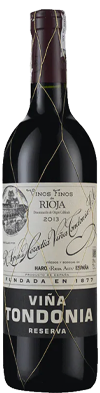
López de Heredia Viña Tondonia Tinto Reserva 2013
An impressive red wine from Rioja icon López de Heredia. Awarded 96 points by Tim Atkin, this is a true Reserva legend.
Interesting facts about the producer
López de Heredia isn’t a tiny “cult garage” story — it’s a serious, continuity-driven estate with an internal logic that’s been sharpened over generations. Their flagship vineyard, Viña Tondonia, is a single, estate-scale holding of over 100 hectares on the right bank of the River Ebro — the kind of vineyard footprint that helps explain the house’s consistency across vintages and its ability to produce wines that feel unmistakably like López de Heredia year after year. López de Heredia also farms three additional vineyards—Viña Bosconia, Viña Cubillo, and Viña Zaconia—bringing the total estate holdings to 170 hectares. Annual production averages around 800,000 kg of grapes, all destined for wines that reflect the house’s unwavering commitment to quality.
The winery itself is extraordinary: a vast, atmospheric network of underground cellars carved into sandstone, stretching up to 200 metres in length and lying more than 10 metres below ground. Here, some 12,900 Bordeaux barrels rest in cool, humid darkness, allowing the wines to mature slowly and gracefully.
Every detail of production is guided by tradition. The estate even maintains its own cooperage—one of the few left in Spain—ensuring complete control over barrel quality and style.
The Wines: Classic Rioja at Its Purest
Long ageing, both in barrel and bottle, is central to the house style. Releases are famously delayed, often appearing on the market many years after harvest, fully mature and ready to drink.
Viña Tondonia Gran Reserva is only made in exceptional years — and when it is made, it follows an ageing schedule that is dramatically longer than Rioja’s legal minimums. López de Heredia states that their red Gran Reserva undergoes an ageing period of 10 years in barrels, racked twice a year, and fined with fresh egg whites — traditional practices that aren’t just “old school” for the sake of it, but part of the house fingerprint that creates that unmistakable Rioja perfume and savoury length.
Visiting the Bodega
The winery in Haro is open exclusively to professionals by appointment, and it closes during harvest. Wine sales to the public are available on select days, though tastings are not offered. Visitors who do enter the bodega often describe it as stepping back in time—a living museum of Rioja’s winemaking heritage.
FAQs
What is López de Heredia Viña Tondonia known for?
López de Heredia is known for producing traditional Rioja wines using long ageing in oak and bottle, often releasing wines many years after vintage.
When was López de Heredia founded?
The winery was founded in 1877 and remains one of the most historic producers in Rioja.
Where is Viña Tondonia located?
Viña Tondonia is located in Rioja Alta, near Haro, along the Ebro River.
What wines does López de Heredia produce?
The winery produces Reserva and Gran Reserva red, white, and rosé wines, including Viña Tondonia, Viña Bosconia, and Viña Cubillo.